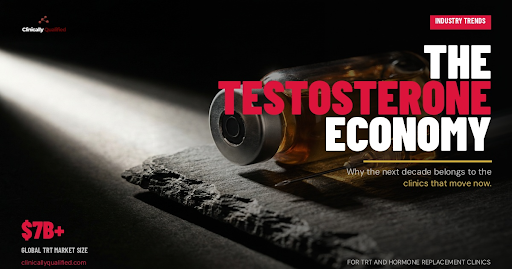
For most of the last two decades, testosterone therapy sat in the shadows. It was something men heard about from a friend, researched at midnight, and then hesitated to act on because the whole category felt slightly off-limits. That hesitation is disappearing fast, and with it goes the quiet ceiling that used to keep men's health clinics small. What is emerging in its place is a genuine economy: a large, motivated, recurring patient base that is only now being served at scale.
If you run a TRT, hormone, or broader men's health practice, the important question is no longer whether the demand is real. It is whether your clinic is built to capture it before the market gets crowded. The clinics that answer that question in the next twelve to eighteen months are the ones that will still be setting the terms a decade from now.
A market that grew up quietly
The growth in men's health did not arrive with a single headline. It accumulated. Telehealth normalized the idea that a man could get bloodwork, a consult, and a prescription without ever sitting in a waiting room. Wearables trained an entire generation to track sleep, recovery, and readiness, which made the idea of tracking hormones feel like a natural next step rather than a medical event. And a wave of podcasts, creators, and public figures made talking about testosterone, energy, and longevity ordinary rather than embarrassing.
Each of those shifts on its own was modest. Together they did something powerful. They took a category that used to depend on a man overcoming stigma and turned it into a category a man now actively seeks out. Demand that once had to be coaxed is now searching for a provider.
Men's health moved from a category you had to sell into a category men now shop for. That changes the job of a clinic from persuasion to presence.
Why this demand is structural
It is tempting to write off any fast-growing wellness category as a trend that will cool. Testosterone is different, because the forces behind it are demographic and cultural rather than seasonal. The population is aging into the exact window where hormone optimization becomes relevant. Men are living longer and expecting those extra years to come with energy and function rather than gradual decline. And the definition of healthcare itself is widening from treating disease to sustaining performance.
- Demographics. A large cohort keeps entering the age band where hormone optimization becomes a live consideration.
- Expectations. Men increasingly treat energy, recovery, and strength as things to actively maintain rather than passively lose.
- Access. Telehealth and modern intake removed the friction that used to keep interested men from ever booking.
- Normalization. Public conversation made the category approachable, so the emotional cost of reaching out dropped sharply.
The GLP-1 halo effect
As GLP-1 weight-loss treatment went mainstream, it pulled an enormous number of people, many of them men, into medically guided optimization for the first time. A man who books a consult to address weight is often the same man quietly wondering about his energy, sleep, and drive. Once he is inside a clinical relationship and seeing results, the conversation about hormones stops feeling like a leap.
For men's health clinics that is a gift. GLP-1 lowered the barrier to entry for a population of men who would never have walked in for testosterone alone. The clinics positioned to serve both the metabolic and the hormonal side of a man's health are not running two businesses. They are meeting the same patient at two moments in the same journey.
Why the window is now
Every growing market follows the same arc. Early on, demand outruns the number of credible providers, acquisition is cheap, and the clinics that show up capture patients almost by default. Then the category gets discovered, competitors flood in, ad costs climb, and the advantage shifts to being the most trusted and the most efficient. Men's health is still closer to the first phase than the second, but that gap is closing.
The cost to acquire a men's health patient will almost certainly be higher next year than it is today. Every month you wait, you buy attention at a worse price than you could right now.
What moving now looks like
Moving now does not mean spending recklessly. It means building the machine that turns rising demand into booked, recurring patients before the competition does. That machine has a few non-negotiable parts, and most clinics are missing at least one.
- Compliant demand capture. Ads and landing pages built to pass health-policy review and still convert.
- Instant follow-up. A new lead reached in seconds, not the next business day, across text, email, and a live call.
- Trained intake. A specialist who can qualify, handle price, and book the consult rather than take a message.
- Recurring relationship. The systems that keep a patient engaged, refilled, and retained across months.
Who owns the next decade
The next decade of men's health will not be won by whoever discovered the trend first. It will be won by whoever built the most reliable path from a curious man to a committed, long-term patient, and kept that path full while everyone else was still deciding whether the category was real.
If your practice is seeing interest but your calendar does not reflect it, the leak is almost always in capture and follow-up, and it is fixable. That is exactly the layer we build and run for hormone and men's health clinics. Book a growth call and we will map where your demand is leaking and what it would take to own your market before it fills up.

Colin Greer
Colin builds done-for-you patient-acquisition systems for GLP-1, peptide, and TRT clinics, from compliant ads through instant follow-up and trained intake. He writes about the business of men's health and metabolic care.